Showing posts with label places. Show all posts

Monday, March 18, 2013

Stories from Segovia

el acueducto de Segovia

When my contract ended last summer, I boarded a bus with teary eyes to embark on a new adventure. My crazy-cool Uncle had decided to cross the pond for a visit! We met up in Madrid and set off, our first stop being not far away, just northwest of the capital in beautiful Segovia! Situated on the meseta in Castilla y Leon, Spain doesn't get much more Spanish than here. Its stunning scenery and easy access from Madrid make Segovia a popular tourist stop, but the Roman aqueducts, the Alcázar castle, and the cochinillo, or roast suckling pig, are what really put it on the map!

el Alcázar de Segovia

The earliest records indicate that the Alcazar began as a fortress during the Moorish invasion of Spain, and then continued to evolve with history. When I say that that Spain doesn't get more Spanish than this, think Queen Isabel I of Castille. After the death of Henry IV in Madrid, this is where she was crowned queen. Not of minor significance, Isabella and her husband Ferdinand of Aragón are credited with ending the Reconquista, starting the Inquisition, sending Columbus to America, and, oh yeah, uniting all of Spain under one rule.

The castle is beautiful (enough so to inspire disney fairy tales!), but imagining the history as I wandered the halls was a different kind of beauty, like sidestepping time. We made it up the tower, with a little huffing and puffing, but the applause from a group of students from Asturias at the top was absolutely worth it!

The applause and, of course, the view...

a view of Segovia


Segovia's historical significance extends beyond Spain's golden age and into modernity, having also been on the front lines during the Spanish Civil War. This history is also a bit more personal, and I was anxious to see it for myself, because a friend of mine is from Segovia and actually lived it. As a child, he remembers, it was an ordinary afternoon that his parents were debating whether his father should go down to Madrid on errands that day, or wait until the next. He went that same day, war broke out, and he couldn't come back for five years. My friend remembers seeing Franco's speeches from the balcony, and watching people run from the square into the church as the bombs fell. It was almost hard to believe as we wandered the same spot on a sleepy summer day, and sipped our coffee in the plaza. 


Segovia is a convenient tourist destination, but it's also a sleepy Spanish town. The man sweeping the plaza was happy to tell me an entire history of the cathedral, another man explained how the aquaduct appeared overnight after a tired farm boy made a deal with the devil to save time fetching water, and when we stopped in at the Mesón de Candido to sample some of Segovia's typical dish, roast suckling pig, the second-generation owner laughed as he wrote me a joke to tell my friend about the small neighboring towns. I loved Segovia for all of its touristic appeals, but I think that what I loved most was the grace with which it shares all of its stories, inviting you to be a part of its history. 

Have you ever been to Segovia? Did you stop in at the Meson de Candido for some cochinillo


Friday, November 30, 2012

Lovely Lisboa

After an impromptu trip to the Canary Islands last year, (and thanks to a little help from home!), Rob and I managed to catch up with our original itinerary in--wait for it--Lisbon! 

colorful streets

casual castles

monuments and monuments

Portugal, once a naval empire famous for producing explorers of the likes of Vasco da Gama, is today one of those little countries you usually hear about as they list off debt figures for the Eurozone. While I can't speak for how Ireland or Greece have reacted to recent economic hurdles, Portugal really left a positive impression of its character. Instead of despairing, the the country seems to be digging deeper to redefine its character. A prominent ad campaign highlighted a reorganization of priorities, wryly noting that while superfluous costs like shoe sales had gone down in the last year, essential commodity purchases had increased. 

Lisbon is a city that shines in its senescence. I was surprised when someone described it is a city that you either love or you hate, but that's probably because I loved it and hadn't imagined an alternative! People who don't fall for Lisbon complain of its decadence, but I think that there is a difference between an ancient city that is crumbling and a history that continues to be vibrant through continued innovation and creativity. To me, both the well-preserved and re-envisioned architecture added a pleasant air of nostalgia to an atmosphere that struck me as quirky and effervescent. With all the European charm but none of the big-time hassle, Portugal's capital city is the perfect place to mingle with tourists and locals to embrace everything the city has to offer.

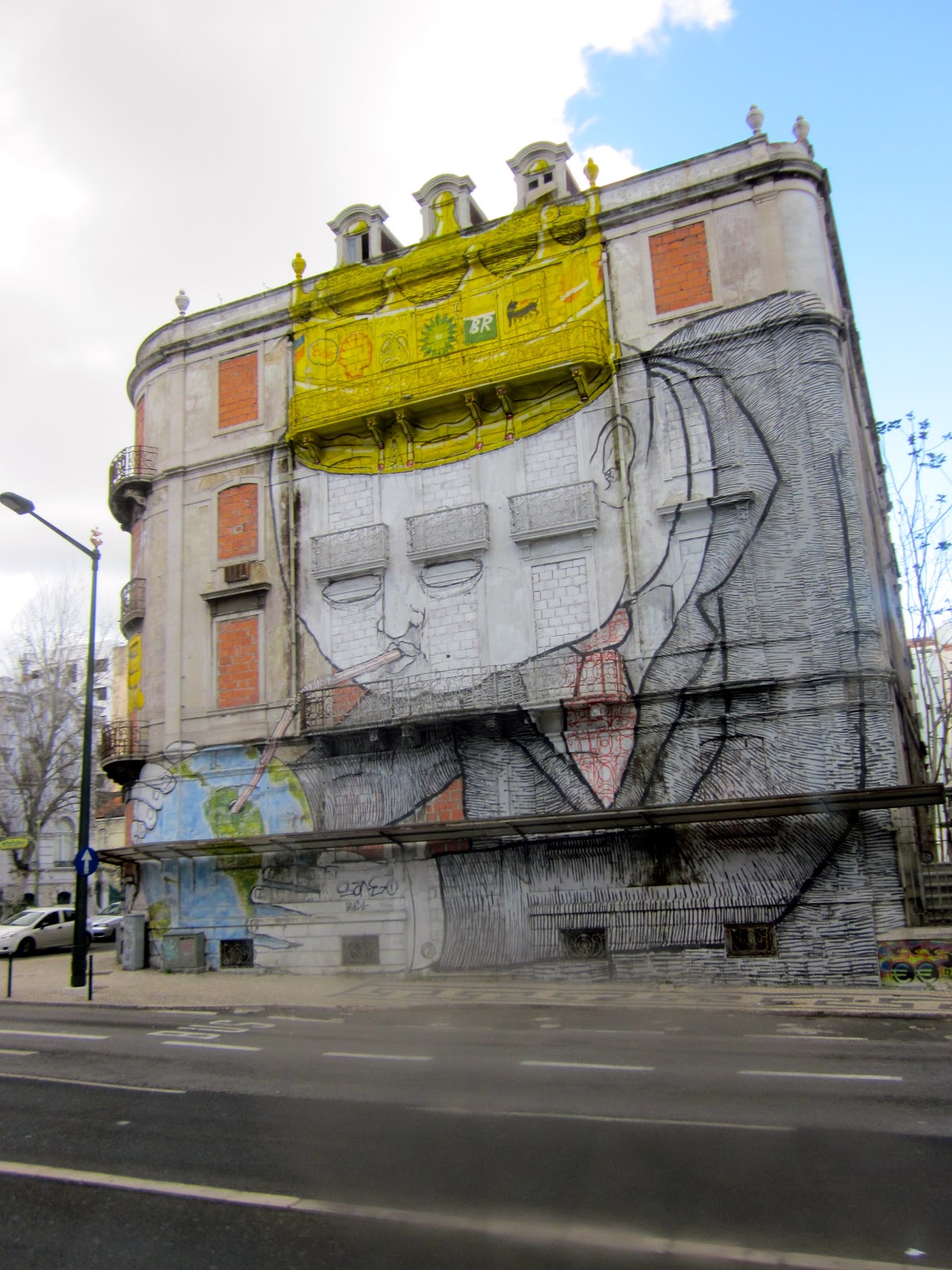
there were a whole series of buildings like this, but I managed this quick shot from the bus!

creativity and colors

not a bad way to take your coffee

Rob and I made our way from the airport to the city center on the aerobus with no problems--public transport is one thing this city seems to be doing right! Between the art-deco train station, the classic yellow trolleys, and the neon metro stops, which you could (and we did!) confuse with art, getting around is not only hassle-free but surprisingly pleasant. A green via card costs just a few euro and it will get you just about everywhere.

train

trolly

metro

We checked in at our pousada then set out to explore. Our hotel was called Dom José, but the staff were so friendly and the building was so quaint that I doubt you could go very wrong on accommodations. Charm seemed to radiate from the city. While Rob and I had our morning coffee we mused at the strange music. "What is that, a didgeridoo?" Rob wondered. 

Yes, it was a didgeridoo. 

even a miser like me had to shell out some change for this guy

Rob and I, having now become quite accustomed to going with the flow, enjoyed the sights of Lisbon as we stumbled upon them in turn. We ran into some luck when we found the San Justa lift. Completed in 1902, the stylish vertical elevator connects the city center, the barrio baixo, with the trendy barrio alto above. Rob and I waited in line to go up, and were the last people allowed to ride for the night! At the top we took in the view and indulged in a delicious, touristy, and of all things, Italian, dinner! 


The next day we visited the San Jerónimo monastery and, exhausted at the end of our trip, took a pleasant nap by the tower of Belém. The beautiful UNESCO sites are symbolic of Portugal's age of discovery, and the monastery is the location of Vasco da Gama's tomb. This is also the birthplace of the delicious pasteis de belem, or natas as they're called in Spanish. We decided to walk back to the Lisbon proper to pass the afternoon, and I was surprised by how quickly the city faded into country. The quiet streets and small gardens could easily be confused with the ones in Galicia. 

Our time in Lisbon was well spent, but far too short. Hopefully Rob and I will make it back soon, and maybe on a pre-scheduled flight this time!


Monasterio de los Jerónimos de Belém


torre de Belém (as seen from our napping spot)


living art

a random encounter

hidden walkways

the 25th of April bridge


Have you ever been to Lisbon? Has an impromptu trip ever delightfully surprised you? 

Tuesday, May 1, 2012

Las Canarias III: Santa Cruz & La Laguna


The north-east peninsula of Tenerife is a world away from other parts of the island. The climate is wetter, the trees are greener, and the cities are bigger. The capital, Santa Cruz de Tenerife, is a proper city with tall buildings and lots of services. Many of the people we spoke with weren't fond of its modern aesthetics, but museums, markets, and quirky restaurants, all within a stone's throw of colonial towns, sunny beaches, and natural trails, made Santa Cruz a win for me. 


The anthropological museum is well known here, and Rob and I were on our way, but accidentally stumbled into the library first, where I was easily distracted by a flyer for an exhibit on Walter Benjamin, who I am familiar with for his writing on translation theory but was curious to know more about. Unfortunately, I was then sidetracked again as we tried to track down this exhibit and we ended up in a very contemporary display addressing gender stereotypes. Not that the exhibit wasn't interesting, but we left a bit dazed and confused and not particularly motivated to focus our attention on other pursuits of higher knowledge. If anyone knows what secret crime the USA perpetrated against Montevideo that could apply to a hypothetical future of the European Union, please explain it to Rob or me. 

Although we only made it to the front door of the museum, the anthropological history of Tenerife is interesting and important. The native peoples are now uniformly referred to as the Guanche, but this is somewhat misleading because the six different islands that make up the Canary chain actually had very diverse cultures. Having lived in the geologically comparable Hawaii where the natives had a highly developed seafaring culture, I was surprised to learn that the Guanche had no navigational skills to note. Genetic markers and linguistic similarities indicate that the inhabitants of the islands were most likely Berbers or other peoples from north Africa who had drifted there by chance, and as a result the communication between the islands was infrequent. My favorite anecdote of this cultural disparity is the treatment of criminal justice. While theft was taken quite seriously on most islands (punishable by head-bashing with rock, eye gouging, etc.), in La Palma there was no consequence, as thievery was instead considered an art. 

As in most stories of colonization, much of the original Guanche culture has been lost. This is especially unfortunate in the case of the language, which was curiously based on whistles. The author of the book I read, though, argues that a significant percentage of contemporary population is genetically linked to the Guanche, and that the culture is still alive and relevant today. Rob and I saw this first hand when it came to the tradition of goat herding. On many occasion our hikes were narrated by the faint sound of goat bells twinkling in the distance, and the goats nearly always left their mark on the trails! And the goat herding culture has had a very important impact on the cuisine: The cheeses! Every island has its own, equally delectable varieties. When I was debating which community to select as a preferred placement I briefly considered the Canary Islands because of how happy I was in Hawaii, and I might have gone through with it if I'd been aware of the abundance of savory goat cheeses! But that's just me.


Rob makes crazy mojito eyes with some delicious mojos!

Half an hour by tram from Santa Cruz is La Laguna, a very different kind of place. Nobody will complain that the city is too modern, as San Cristóbol de La Laguna has retained all of its two-story colonial charm. The university is located here, and after an afternoon of meandering I confess that I was daydreaming about applying! It's a colorful city that favors pedestrians, and Rob and I were there on a holiday so the streets were extra crowded. I've also noticed that Rollerblading seems to be making a comeback in Spain, as some trendy people wove around us and through the crowd more than once. We ambled through the streets and Rob waited patiently as I gravitated to a few hip shops, then we followed a churros & chocolate sign into a café where we could people watch. 


We snuck in here to break up our walk with a coffee--it doesn't take too much convincing to assimilate this aspect of Spanish culture!

The natural park to the north-east of these two cities is different from the parks below. The roads are equally as ridiculous and winding (they bring a whole new meaning to scenic byway), but the moister climate means greener trees and a completely different landscape. This is as close as the island of Tenerife comes to a proper forest. Many people continue to live traditional lifestyles here, and I was impressed with their ability to cope with the ups and downs. Literally. Rob and I spent a long while breath-taken at a scenic overlook, during which time we observed that someone actually had a zip-line to their home, and we watched as an ancient man slowly emerged from the hillside and took a seat on the side of the road. We offered him a ride to the next town, and on the way he explained to us that he makes that hike most days: Up the mountain, down the mountain, and back again. I smelled hyperbole, though, when he claimed the trip took him only 20 minutes. An athletic person might take at least an hour, and Rob and I would probably take three, so that hunched-over old man would likely land somewhere in the middle! 

We did our own bit of upward climbing during a hike on the north coast of the park. It started off serene, wandering along the rocky coastline, but after the last small village it took a sharp turn straight up. I was more than flushed by the time we reached the last house, with a tiled address that read "1"--I can't imagine who delivers their mail! The trail continued ten times farther up, conveniently tucked into a valley isolated from the permanent island breeze, but we pressed on and like most challenging endeavors, the view from the top made it all worthwhile!


Rob and I were enchanted with this beautiful road carved out of rock, and even more impressed that it lead to nowhere!